Let’s break it down.
⚠️ This post discusses sex, gender, sexuality, bullying, and discrimination. If this isn’t your thing, grab a snack on your way out.
Neurodivergent people are queerer than average. By a lot. Why?
Depending on the study, somewhere between 30% and 70% of neurodivergent people identify as LGBTQIA. Autistic people are more likely to be trans or asexual. Most autistic women identify as lesbian, bi, or queer.
Bisexuality is more common in neurodivergent men, and ADHDers of all genders are more likely to be in polyamorous relationships or into kink.
If you’re in these communities and bamboozled by the flood of late diagnoses, it’s not in your head. Go ahead and check off “Am I neurodivergent?” on your bingo card while you’re at it.😁
It took time to settle on the labels of “neurodivergent” and “queer”. After lots of self-doubt and soul searching, I eventually landed on queer, because it’s easier than going into full detail: feminine, nonbinary, and sometimes, no desire at all. Neurodivergence took longer to realize, because when I was growing up, ADHD and autism were boys’ problems.
Both queerness and neurodivergence show up in childhood and adolescence. Is it because of how we’re socialized, or are we built differently? We share a common experience of being bullied over our differences and finding community outside of the dominant culture, making it easier to ask “why?”
Seeing society’s flaws through the lens of neurodivergence
There’s something about being an outsider that makes it easier to ignore what society says we should do because it’s easier to see the flaws and hypocrisy. After all, why settle for someone you tolerate instead of someone you’re actually attracted to because it’s the “right” thing to do?
I tried that. It was the 90’s, and heteronormativity was king. I regret it now, because those partners deserved to have someone who had more than a tepid interest in them.
Coming out was a process of reading and self-reflection, something I was pretty good at. Eventually, I came to the conclusion that attraction is attraction, regardless of what their outside looks like.
Turns out, my experience is pretty typical for neurodivergent folks. We don’t know if this is because of our early traumas or if this is how we’re wired. If we’re already seen as abnormal, what’s to stop us from wondering how right the heterosexual “default” is? And if multiple consenting adults all want to be in a relationship together, why is that taboo?
Moreover, what’s with this whole “gender” thing? Why is it only “male” and “female” in western culture, but other cultures worldwide recognize more than two genders?
Neuroqueer outsider: rejected twice, always resilient
It’s hard being a neurodivergent kid. While you try to find and read the fuc– er, fine manual that somehow got lost in the mail, bullies and your own missteps lead to loneliness and despair. Unlike kids today, I didn’t have to deal with assholes following me home through my phone. For many, masking becomes the only viable survival strategy to fade into the background along with your sense of self.
Neurodivergent queer kids get this twice over. Not only are they singled out for their oddness, but as their sexuality becomes clearer to those around them, their social circle shrinks further during a time when everyone is trying to find where they belong.
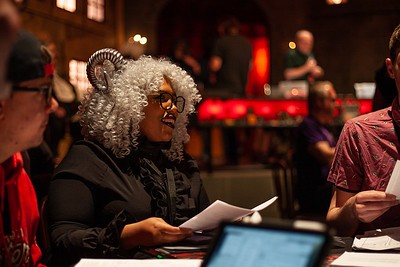
This leads us to find more accepting subcultures: punk/emo/goth, science fiction/fantasy fan groups, gaymers, drag, anywhere we can bond over being social rejects.
Here, we finally find acceptance, safety, and connection instead of assumptions.
Crushed by stereotypes about neurodivergence and queerness
It’s assumed that autistic people don’t want sex. Meanwhile, rumor has it that ADHDers are all sluts. And queer people? Weirdos with funky colored hair and piercings in surprising places who will sleep with anything with a pulse.
There’s a broad range of sexuality and desire found among neurodivergent people, from the cultural standard of cisgender, monogamous, and heterosexual to radical agender pansexual polyamory.
“Queer” is a very broad term that encompasses a lot of people and preferences. Some may be highly sexual, while others remain celibate. One person may be open to dating any and all expressions of gender, while others, like me, have a narrower set of preferences.
Stereotypes shove us into a box, removing our agency and personhood. When queerness and neurodivergence collide, we’re exploited or the victims of violence. Sometimes both. We’re not seen as individuals, but as a pariah that needs to be “fixed” when all we want is to have a meaningful life and a community that lets us express ourselves. Instead, we’re pushed to the margins of society, where we finally find community.
Twice erased, but still queer
The experience of queerness and neurodivergence is eerily similar. We’re pressured to be “normal,” which changes, depending on who’s talking. We’re left to deal with our restrictive, typecast roles and the disadvantages that come along with them.
Schools, lawmakers, and media blackball and erase us from public life.
Sex ed left us out
Both neurodivergent and queer people are overlooked when it comes to learning about sex and sexuality. Sex ed in schools is abysmal. In the US, it’s common to get a quick sermon on the dangers of STIs and how abstinence is the only option for horny teenagers. There’s little, if any, discussion on other topics surrounding sex like non-heterosexual identities, consent, abuse, masturbation, and pleasure.
It’s an uncomfortable topic to have around children, particularly disabled kids. But studies are pretty clear: age-appropriate sex education has better outcomes over our lives. As these children grow into adults, they’re less likely to find themselves in exploitative or abusive relationships (common among autistic girls) and more likely to form healthy, stable attachments as teens and adults with fewer unplanned pregnancies and STIs.
Autistic kids need a little extra support here. Our social difficulties make relationships harder, since we miss cues or come off in ways we don’t intend to. Instead, we’re left to figure it out on our own.
The system fails neurodivergent and queer communities
Marginalization doesn’t stop at school. We’re banned from bathrooms, sports, healthcare, and even dressing in a manner that feels right to us. After a long fight for marriage equality in the US, we’re facing the possibility of losing it once again.
At the same time, the US health department keeps sending out junk science saying that chemicals cause autism despite extensive studies that find no link.
Lawmakers and institutions are working overtime to erase us.
And if you have a visible disability or are BIPOC? There’s even less out there and more micro-and macroaggressions to deal with in everyday life.

Media stereotypes do us dirty
More often than not, we find trans and queer-coded characters as villains, sex workers, or dead. We’re at the margins and seldom, if ever, protagonists.
When we’re not punished for our queer sins, we’re fetishized as the Manic Pixie Dream Girl. She’s both autistic/AuDHD and queer-coded with her bright hair and quirky fashion, but she’s always interested in the white-bread protagonist idolizing her. Despite how she’d actually be in real life, she’s usually straight and occasionally bisexual, and hides her autistic traits outside of her odd but cute special interests.
She could be interesting. She could struggle with coming to terms with her sexuality, gender, or navigating a healthy relationship. She could struggle with giving up her comfortable solitude versus her attachment to another, or work through past traumas that are roadblocks in her current relationship. Anything would be better than a stale character that could be replaced with a sexy leg lamp.
The autistic coded Sheldon/Sherlock type is a brilliant asshole. Sherlock’s asexuality is not addressed in the original stories (blame the Victorians), and poorly handled in modern adaptations with passing mentions and none of the stigmas or pressures asexual people face. Sheldon’s inability to understand people is played up for laughs, instead of diving into the shame and anxiety it brings to the table. Both reduce autistic men to obsessive jerks, but if he’s the hero, he can still have a beautiful woman as a reward for his good deeds.
There are shows out there with good queer representation, like Steven Universe, but they’re rare. But there’s hope: queer, neurodivergent artists like Billie Eilish show the world our true potential.
What dysphoria feels like when you’re autistic
Autistic people are more likely to be trans, nonbinary, or agender. Perhaps this comes from the freedom to question norms when you’re on the outskirts of society, or maybe it has more to do with the deep discomfort of being in your own body. (probably a little of both)
I don’t have a lot of experience with dysphoria myself, aside from having to wear a uniform with a tie and feeling anxious and guilty over my body size. I reached out to some friends who are both autistic and trans who were kind enough to talk to me about their experiences. Big thank you to them!
Changes are difficult for autistic people, and when puberty hits, it can feel more like mutation than growing up. The body they were used to begins to alter itself without their knowledge or consent, morphing rapidly into something unrecognizable. Emotions around menstruation, body hair, and other physical changes linger and fester into deep discomfort and anxiety.
The survival strategy of masking makes it harder to know what they’re truly feeling, as well as those with more pronounced alexithymia. Is this normal, or something else under the surface? One friend knew when they were around ten. Fortunately, they have a supportive family and were in a better position than many others. Another friend struggled behind their mask, knowing something was wrong but never being able to put a finger on what it was until years later.

It’s hard to force yourself to fit into the gender assigned to you at birth when you feel wrong in your own skin. Demand avoidance digs in its heels, refusing to follow along and shouting, “This isn’t me!” If the box of your assigned gender doesn’t fit, it doesn’t make sense to keep cutting off parts of yourself until you pass.
If you have an autistic loved one questioning their gender, offer them a safe space. Listen, empathize, and help them navigate executive dysfunction and anxiety to get them the care they need.
We’ve always been here and we’re not going anywhere
Neurodivergence and queerness are parallel paths that converge for many of us. My childhood was typical for someone with AuDHD, but did that ostracization lead to my years of questioning sexuality and the norms surrounding it before settling on an answer that felt the most truthful to me? Or was I always primed for queerness (I have other queer family members) and my neurodivergence is a happy accident?
It’s not easy feeling like an outsider. It’s harder to form friendships or even feel a part of subcultures and communities of people like you. But somehow, we find our tribe, full of neurodivergent queer people like ourselves. Each member of this found family is precious: they are the safe haven your inner child needed but didn’t get. Whether it’s online groups, the friends you make at cons, your ride-or-die drag mother and sisters, an inclusive D&D group, or the friends who always meet up for the Pride parade, every voice that says “I know who you are and love you anyway” helps us build happier, more fulfilling lives.
If you see yourself here, I see you, too. Go find your tribe and the people who accept you in all your neurodivergent goblin weirdness. If you’re looking for one, hop on over to my facebook page and start a conversation.
After all of this, I need a puppy palate cleanser! Next time, I’m letting my dog nerd flag fly with a dive into the importance of enrichment.
 Amy Writes Things