
How to Find a Good Dog Breeder Without Getting Scammed

The Wrong Breeder Will Break Your Heart… And Your Bank Account.

Nearly half of U.S. households have at least one dog, and over 2 million puppies are sold each year. Most come from commercial breeders, but like any unregulated industry, practices range from exceptional to criminal. It’s a buyer beware market, and it’s up to us to know the difference.

With a few clicks and a little (or a lot) of AI help, anyone can create an attractive, legitimate-looking website. While I love being able to order emergency underpants at 2 in the morning, purchasing a puppy shouldn’t be as simple as buying a screaming goat figurine. 

There are good dog breeders out there, but they rarely show up in the first few search results. It’s worth the time to find our new best friend without funding breeders who care more about money and the latest “designer” dog fad that hides health and behavioral issues, as I covered in my previous doodle deep dive.


Prefer to listen?

Neuroqueer: At the Intersection of Neurodivergence and Queerness Amy Says Things


The Best Breeders Aren’t Where You Think They Are 

The best way to find a good breeder is to take your search offline. They don’t have time for flashy websites or active social media: they’re busy going to shows, training, participating in sports, or working their dogs in the field. Dog shows and sporting events are filled with dog nerds who can tell you who’s good and who you should avoid. Breed-specific clubs can point you to local meetups and events. 

If you’re interested in a particular dog sport or activity, attend events and talk to participants and watch your potential dog in action. Seeing a Belgian Malinois crush it at a Schutzhund trial gives you a solid idea of how athletic and intense they are, and their handlers can help you decide if a malligator is a good fit for your family and lifestyle. (Spoiler: the answer is “don’t get one unless you’re nuts”)

If you’re allergic to people, disabled (or live with someone who is), or live in a rural area, breed specific websites are a good place to start. Social media groups are hit and miss. There are genuine experts in them, but they’re outnumbered by pet owners, loud opinions, and the occasional grifter. You can spot the dog nerd by their 1,000+ word essays, complete with footnotes and citations.

Why “Available Now” Puppies Are a Bad Sign

You’ve fallen in love with a breed, found good advice from fellow enthusiasts, and even have a few recommendations. Now all you have to do is visit their site, order your puppy, and start your life with your new bestie, right?

Wrong.

Now the real work begins. 
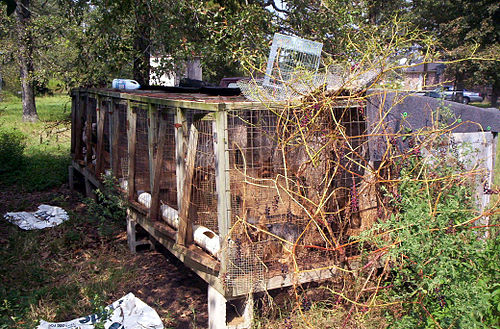
A row of poorly maintained wooden cages found at a puppy mill. There is debris on top of the cages and on the ground in front of them.

Start with the Humane World’s Horrible Hundred list. It highlights the worst puppy mills and hoarders keeping dogs in inhumane conditions while selling sick and undersocialized puppies to unsuspecting buyers. It’s a solid place to start, but plenty of unethical breeders don’t make this list. 

Red And Green Flags

They’re not one of the Horrible Hundred? Great! That’s the first (and easiest) step.

Head on over to their website and be skeptical. Treat cute puppy pictures like dessert and save ‘em for last. The best breeders have informative sites worth bookmarking instead of just puppies for sale.

Look for badges from professional associations like AKC’s Bred with H.E.A.R.T, and other breed clubs, usually at the top or bottom of the page. They’re not guarantees, but there are minimum standards breeders have to uphold in order to be in good standing with them. Take note of any you find, and check out the associations to see if their standards align with your expectations. 

Look for breeders who produce champions, even if you don’t plan on showing. Not every puppy is cut out for the ring, but those that aren’t make excellent pets. “Champion line” is meaningless and often a sign of overbred, undersocialized dogs. These dogs have a much higher chance of genetic diseases and behavior problems.


⚠️ Red Flags Beyond Comic Sans 

  • Typos, broken links, or sites built on free templates.
  • Tons of puppy glamour shots with nothing on parents.
  • “Clearance” sales or “rare designer colors.”
  • Affiliate link spam or MLMs.
  • Puppies shown on multiple websites or in stock photos (run a reverse image search!).

What To Know About Health Testing

More buyers know to ask about health testing, and I’m here for it. The gold standard comes from the Orthopedic Foundation for Animals (OFA), an organization dedicated to reducing genetic diseases in companion animals. Breeding dogs are tested for both genetic and joint diseases and are searchable in a public database. Puppies can get preliminary testing on their joints.


⚠️ Red flag: breeders who only list preliminary OFA results (or none at all).


Make sure their vet is a licensed DVM, and that a vet administers puppy vaccines. Avoid anyone who does their own vaccinations or has their vet tech/vet assistant “friend” do them. Breeders who do this put everyone at a higher risk of disease.

Buyer Beware: Facebook Puppies and Barking Vet Bills

During my research, I ran across a site that featured a happy celebrity holding one of their dogs. Sure, it’s exciting for the breeder, but a celebrity endorsement doesn’t mean jack when it comes to their health or temperament.

A black and white French bulldog looks at the camera with a smile. Frenchies and other popular breeds are common victims of puppy mills.

Image via freepik.com

When someone is offering a rainbow of popular small and toy breeds, there’s a good chance you’re looking at a puppy mill. Mothers are stacked in cages in a misery parfait, and you’re going to inherit some problems.

Some bully breeders advertise their dogs like a UFC promo. Look closely: you’ll see an alarming amount of inbreeding sold as “proof” of their quality. If their family tree looks like 16th century European royalty, it’s a genetic time bomb. You’re going to shell out big bucks at the vet, and if you’re really unlucky, a behaviorist.

For the love of everything holy, do not buy puppies from Craigslist, Facebook Marketplace, or broker-style websites. These places are full of scammers plus the worst backyard breeders and puppy mills. I’ve known more than one heartbroken pet parent who lost their brand new puppy to parvo, only to be ghosted by their “breeder.” These people don’t deserve your hard-earned money.

Trust, But Verify: See Through BS to Find Reputable Breeders

It’s not enough to take a breeder at their word. 

  • Call up their vet and see what they say. If they’re good, the vet, or at least their front desk, will happily sing their praises. 
  • Go to OFA.org and look for the parent certification. (and puppy, if provided)
  • Cross-check their breeder associations and make sure they’re in good standing.

Anything and everything that leads to an outside source has to be double-checked.

A woman kneels down to greet a Pomeranian puppy exiting a plastic carrier. Puppies sometimes travel thousands of miles from their breeder in order to get to their new home. 

Image via freepik.com

⚠️ If they say “trust me, bro,” assume they’re shady. 


Five Stars or Felonies? Know Who You’re Dealing With

Breeder websites naturally cherry pick the best reviews. What do Google, Yelp, and social media say? Is it consistent, or are there a lot of angry people complaining about the breeder elsewhere?

Next, head over to the Better Business Bureau and check for complaints and reviews. A high rating means they respond to customer complaints, but won’t tell you if they’re ethical.

Finally, look for any civil or criminal complaints against the breeder or their business. A good breeder might get sued (it happens), but anyone with several civil cases or animal cruelty charges should never get your business. 

Pre-Puppy Playdates Help You Find Breeders Who Pass The (Literal) Sniff Test

You’ve found a breeder you like who seems reputable! Woohoo! It’s time to visit them in person to see if their dogs are worth your money. 


❔Ask yourself, “Would I be comfortable leaving my dog here?”


Breeder Green Flags You Should Look For

These are all signs of reputable breeders:

  • Happy to let you meet parents and any litters being socialized
  • If dogs are kept in kennels, they are clean and well-maintained
  • If dogs are kept in the home, it’s tidy with a separate whelping area
  • Breeder is knowledgeable and encourages questions
  • Transparent about any issues and provides documentation
  • Has puppy socialization plan and can explain it to a five-year-old
  • Clear about next steps, policies, and contracts

These Are Dealbreaking Breeder Red Flags

⚠️ Don’t let their bad practices become your problem.

  • Won’t let you meet parents, visit facility, or wants to meet elsewhere
  • Dirty, smelly, or chaotic environment
  • Vague or evasive communication
  • Payment only through cash, Zelle, Venmo, or gift cards
  • High pressure sales tactics
  • Selling puppies younger than 8 weeks old
  • Unusually high or suspiciously low prices
  • “Exclusive” or “rare” coat colors 
  • No contract, or filled with clauses like going to a specific vet, a particular diet, or using supplements that they sell (How… convenient.)
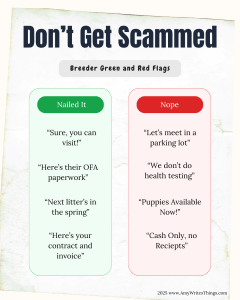
Infographic titled "Don't Get Scammed: Breeder Green and Red Flags" A good breeder will let you visit, show you paperwork, won't have a puppy for you now, and has a contract and receipt for you.

Spot the Good Ones and Stay for a While: Questions to Ask Your Breeder

Good breeders want you to ask questions. Their dogs mean a lot to them, and they want puppies going into good homes.

They’ll also want to know about you. Expect questions about your experience with dogs or the breed, vet, income, housing, current pets, and other members of your household.


💬 Here are some potential questions you might want to ask your breeder: 

  • Who is your vet? 
  • How long have you been breeding dogs?
  • What’s the average lifespan of your dogs?
  • Have any past litters had health or behavioral issues?
  • What age do you begin breeding your dogs?
  • What’s the best way to get in touch with you if I have questions?
  • What happens if I run into problems or can’t keep the dog?
  • Can I review the contract before I sign anything?

Skip Genetic Roulette and Avoid the Puppy Mill Trap

Wading through the toxic sludge of scams, shady breeders, and instapuppies is exhausting. Unfortunately, the burden falls to us in unregulated industries, but we can avoid them with the right tools.

A happy couple cuddles with their yellow lab. The dog's head is on the man's lap, while his partner looks at their dog from the bed, her hand on his shoulder.

The more time you spend finding the right, instead of the first, breeder will mean you bring home a healthy puppy for a lifetime of fetch, wigglebutts and wet noses.

Have you ever bought a puppy from a breeder? What was your experience? Share your story below.

Prefer podcasts over paragraphs? Catch the audio version here.

Doodles: Best Dog Ever or a Ticket on The Hot Mess Express?

Doodles are cute, but pet professionals call them a nightmare. Learn what doodle owners aren’t told and how shady breeders set everyone up to fail.


Prefer to Listen?

Neuroqueer: At the Intersection of Neurodivergence and Queerness Amy Says Things


Are Doodles More Controversial Than Pit Bulls?

An apricot colored goldendoodle sits beside a bowl with a toy in the background
Image via www.pickpik.com

Doodles are an intelligent, friendly, and low-shedding dog with a devoted following, but they’re very polarizing . Those that love them ask, how could anyone hate such a cute, goofy, cuddly, and sweet dog?

But if you ask a pet professional about the dog they don’t want to work with, doodles top the list. Every one I know has at least one horror story of a matted, hyperactive, mouthy doodle.

What’s going on here? Why is there such a big disconnect?

Designer Dogs Have Hidden Costs

Labs and goldens are family favorites because of their sweet, easygoing nature. It was easy to find them and their mixes in shelters, but they’ve been replaced by bully breeds and huskies. Although bullies in particular make great family dogs, they’re intimidating for first time pet owners, unlike a doofy lab mix. Nowadays it’s easier to find a non-bully mix from a breeder.

When you have a specific dog in mind, like a doodle, it’s easier to find a breeder than risk the behavioral crapshoot with a rescue. Personally, I’m an “adopt, don’t shop” girlie, but there is a need for breeders committed to producing litters of healthy, stable puppies that thrive in family homes.

A designer name comes with a hefty price tag, which means the dog has to be irresistible, and doodles are adorable. Even the most jaded pet pros lose their minds over large dark eyes and curls. Those puppies are next-level cute!

But pros know the doodle’s dirty secret: most buyers get their dog from breeders who care more about profit than the dogs they produce.

Doodles Are Marketed as a Product, Not a Pet

Doodles are sold as a low-maintenance, trainable dog that’s good with children. Websites feature children hugging puppies with teddy bear faces or wearing service dog vests, promising the perfect family companion. Like Amazon, they’re set up to lure you into impulse shopping.

They don’t tell prospective buyers about their upkeep or potential pitfalls. That’s for you to discover on your own to a chorus of “You didn’t do your research!”

They call themselves a “family operation”, but having three or more whelping mothers and no pictures of their living conditions means this is a business, not a home. Health testing is optional, and if it’s mentioned, used as proof that they’re not one of those guys.

Enthusiastic reviews are prominently shown, while unsatisfied customers quietly disappear. 

Doodles sold through puppy brokers or pet stores aren’t any better. They’re removed from mom, transported, and isolated in cages during a critical socialization period. It’s a recipe for lifelong behavior problems.

When the perfect puppy is anything but, owners are told that it’s a buyer beware market and they fell for one of the bad ones. But when doodles are sold the same way you’d buy a kitchen gadget from TikTok, is it any wonder when things go wrong?

Doodle Problems Begin in the Puppy Mill Pipeline

Aesthetic websites hide a dark reality of overbred, neglected mothers used until they are no longer profitable. Stressed out moms have anxious puppies, who are sold with no one the wiser. Diseases like parvo, distemper, and kennel cough spread quickly in overcrowded conditions, and buyers, not breeders, pay the vet bill. 

Health falls to the wayside when looks are everything. Exclusive coat colors like merle bring in more money than a boring chocolate brown, but a double merle dog is a walking vet bill. They want a wavy coat for the perfect teddy bear cut while ignoring genetic diseases. Both the dogs and their guardians pay the price.

Yes, a dog from a puppy mill can be a great pet. I have one: Kyleth. Her previous owner raved about how lovely the Amish family that produced her was, but I instantly knew that I had my work cut out for me. I love her, but she’s a handful with emotional and health problems that I’ll be managing for the rest of her life. None of that stops her from being a silly, cuddly little gremlin I adore.

This isn’t to say that everyone breeding doodles is a backyard breeder or running a puppy mill. There are many breeders dedicated to breeding great family dogs. It’s expensive, with pre- and postnatal care for mom, vaccines and deworming from the vet for everyone, and health testing in addition to early socialization in a home environment.

A Low Maintenance Doodle Doesn’t Exist. 

A matted doodle from a groomer on r/doggrooming. A doodle sits on a grooming table facing away while the groomer holds their severely matted coat, which is coming off in one piece

Doodles need regular grooming every four to six weeks, an expense that gets downplayed. If a family is not prepared for it, their dog’s neglected coat tangles into painful mats that cover their entire body. Groomers usually shave them, both for the dog’s comfort as well as their safety. Shaving a matted doodle isn’t a shortcut, it’s a tough task! Ever try to shave a hyperactive, stressed out 60-lb toddler with sharp teeth and no way to tell you if something hurts? 

Pet parents get upset when their doodle has to be shaved, putting the groomer or salon on blast on social media. Bad behavior from both dog and owner is a major reason that groomers refuse to take them on as clients in the future.

When it comes to their daily care and puppy raising, women take on the bulk of that responsibility whether or not they want to. It’s hard enough to juggle a busy family and a full time job without the added stress of a high maintenance dog. Ten minutes of backyard fetch isn’t a replacement for a walk, but when she’s exhausted after a long day, I get it. 

Neglected Doodles Are a Nightmare for Pros

Across social media, people looking for help for their doodle’s behavior issues are met with enthusiasts telling them it’s somehow their fault. Professionals, worn thin by years of out of control dogs, get resentful and dismissive. Everyone’s pointing fingers, and no one’s helping.

 Trainers, vet techs, and daycare attendants walk away with bruises, scratches, and more resentment, even when the pet guardian is doing their best. Working with an untrained, hyperactive doodle is like wrangling a kangaroo hopped up on Red Bull. It’s exhausting and very hard on the shoulders!

People know when their dog’s behavior is too much, so they seek out help from trainers. Group training classes are cheaper, but when it’s so overstimulating that managing the doodle class clown bogs down the lesson, you find yourself in more expensive private lessons, or worse, the trainer dropping you from class.

Love the Dog, Hate the System

Doodles are not bad dogs, but they’re not for everyone. They thrive in homes that can afford their upkeep, give them structure, and make them the center of attention like the teddy bear divas they are.

Bad breeder websites, pet stores, and puppy brokers encourage impulse shopping instead of thoughtful consideration. Online groups can be dismissive of genuine behavior problems, and professionals bear the brunt of bad behavior from both dog and owner. It’s the system, not the professionals or the people who fall in love with doodles, that fails us all.

Image of a goldendoodle with a small bow on their forehead resting on a gravel surface with spotty grass in the background.

Image via pixhere.com

Next time, I’ll talk about how to spot the difference between puppy mills and reputable breeders.

 If you have a doodle, what have you struggled with? Let’s help each other in the comments below.

Prefer podcasts over paragraphs? Catch the audio version here.

How do I find good dog food brands when there is so much conflicting information?

Food is love, especially if you have a labrador retriever! Good nutrition helps our pets live longer, healthier lives, and I want to make sure that my dogs have a long, happy life with me. That means regular vet visits, exercise, and good nutrition.

If you go to your neighborhood big box pet store, you are met with aisles upon aisles of choices, with pictures of wolves, smiling dogs, rustic nature, and healthy, raw ingredients. Do you get the one that has a picture of your dog or a breed-specific formula, or do you opt for the one that looks like it uses all natural ingredients, or that claims to appeal to your dog’s primal instincts? Do you grab cans instead of kibble, or how about the refrigerated or frozen food? Is that better? It’s enough to make you run in and go for the nearest random bag of something that you recognize and hope that there’s no poopsplosions. 

But then you go online, and in one nutrition group, they say that raw, home-cooked, or fresh food is best and if you feed kibble or canned, you’re giving your pet cancer. Then another says that grains are poison and you need to feed them a high protein diet, even if the only cardio they get is the happy dance when you get home. On another corner of the internet, they won’t allow discussion of anything unless it passes WSAVA muster. 

Going to your vet to ask about nutrition only leads to more questions. They recommend only a few brands, and most people on the internet disagree with their opinions. 

It’s enough to make your head spin, and it’s a question I get asked a lot as a dog trainer. My short answer is to feed whatever your dog thrives on that’s within your budget, and this is how I break it down to find what’s right for me and my dogs.

How much effort do I want to put into feeding my dogs?

Some people show love through food, and for those who love the idea of cooking for their dog, it’s a healthy, viable option. I personally don’t recommend raw diets, but for those who decide to go down that route, bacterial contamination is a serious risk and you need to take steps to protect your dog and other household members from food-borne illnesses.

Most pet owners prefer to feed some sort of pre-packaged food. Kibble is king here, and it’s easy to see why. It’s everywhere from dollar stores to boutiques, it’s shelf stable, easy to transport, cost effective, and easy to feed. It’s a fantastic option for those who don’t want to dive deep into canine nutrition, and is my go-to choice for my dogs. 

AAFCO and WSAVA: What are they, and how can they help me find quality pre-made food?

Pet food in the US must meet the Association of American Feed Control Officials, or  AAFCO standards. This guideline gives a general target for the minimum and maximum percentage of nutrients in a food that is marketed as “complete and balanced” to ensure that what you’re feeding fits within the safe limits for your pup. 

If you check your bag of dog food, you will find the AAFCO nutritional adequacy statement somewhere on the bag, either near the ingredients or the feeding guidelines. It will say either “<dog food> has been formulated to meet the nutritional levels established by the AAFCO Dog Food Nutrient profiles for <life stage> of dogs.” or “Animal feeding tests substantiate that <dog food> provides complete and balanced nutrition for <life stage>” Those life stages are growth, gestation/lactation, adult maintenance, or all life stages. Puppy food is usually broken down into food for dogs who will be under 75 lbs as an adult and those over, because the nutritional needs for large and giant breeds are slightly different from smaller dogs. 

Food that is not appropriate for daily feeding will say “for intermittent or supplemental feeding only,” which means it can lead to nutritional deficiencies and related illnesses if fed daily for years. 

AAFCO guidelines answer the question, what are the minimum levels of protein, fats, and the proper vitamins and minerals that a pet or farm animal needs to survive? They do not test, approve, or certify pet food, but the standards are used here in the US to ensure that pet food meets an animal’s minimum nutritional requirements.

The World Small Animal Veterinary Association, or WSAVA, is a community of vets worldwide with the mission to advance the health and welfare of pets. This expert community set up its own guidelines for pet nutrition,  and has a wealth of information on how to read pet food labels and their guide for finding quality dog food and a set of questions to answer in order to find which companies are using science instead of human food trends in their formulas. Like AAFCO, they do not approve, test, or certify any brands. 

These questions are

  • Do they employ a nutritionist with PhD in Animal nutrition, or one with ACVN, or ECVCN certifications who helps to formulate the food?
  • What’s their quality control, and how much of the manufacturing process do they oversee? 
  • Do they do research into nutrition, and if they do, do they publish anything in peer-reviewed journals?

You can usually find this information on the pet food manufacturer’s website or by emailing them. Companies that follow these guidelines are more likely to have high quality formulas for pets than those that do not meet those standards.

Most pet food brands do not meet WSAVA guidelines. Iams, Eukanuba, Hills Science Diet, Purina, and Royal Canin do. We’re starting to see more companies, like The Farmer’s Dog, are employing qualified nutritionists after the FDA began studying the link between Boutique, Exotic protein, and Grain-free (BEG) diets and Dilated Cardiomyopathy (DCM).

If your favorite brand does not meet WSAVA guidelines, does that mean it’s bad? Not necessarily. While I personally won’t choose a food that isn’t formulated with experts, not all companies have the resources to do research or testing on formulas and instead rely on testing done by other companies. These foods are usually fine and won’t make your vet’s eye twitch when you mention them. 

Kibble or canned?

I use canned food as a topper for my kibble once a day because I love to see Kyleth’s little happy tap when she sees the can, but some dogs prefer a canned or moist diet, or must be on a canned diet for health reasons. Canned diets follow the same laws as kibble, so many of these rules still apply, although percentages of moisture, meat, carbohydrate content, and fat are different from the same brand’s kibble. If you like the idea of feeding something that looks and smells more like meaty deliciousness, or if your dog refuses to touch kibble but goes to town on a can of food, there’s nothing wrong with an exclusively canned diet.

Canned food makes an excellent topper for dry food, which is an easy way to spice up your dog’s bowl without monkeying around with the nutrient balance. 

What’s in an ingredient list?

“Read the ingredient list” is common advice when it comes to finding good dog food. It’s sound advice, but it’s important to look at other information on the bag as well, such as the calories, fat content, and feeding guidelines. I use the ingredient list to see if the food sets off any of my red flags. 

  • Red flag 1: “Fairy Dust”
    Ingredients are listed by weight, from most to least. There’s no indication as to how much of each ingredient is in the food, so it will give you a general idea of what’s in the food, but not the proportion of each ingredient or the total weight of them. The first five ingredients make up the bulk of the food, and anything listed after the vitamins and preservatives are in such small quantities that they provide no meaningful benefit to your dog. They’re fairy dust that makes the food look more enticing to those who read the ingredient list.
  • Red flag 2: Ingredient splitting
    Some companies employ a little trick called ingredient splitting to make an ingredient list look better to consumers. They may want to avoid the word “byproduct” and will list heart, lungs, and liver separately to avoid the term and move grains further down the ingredient list. Others will split up grains, peas, or other legumes so that they fall farther down the list, making the food appear meatier or more enticing to consumers. I won’t buy food that splits ingredients, because it’s a deceptive practice and can make a lower-quality food look better than it actually is. If I see a meat, meat meal, and then organs of an animal listed, or if I see multiple instances of peas or the same carbohydrate, I move on to something else. 

AAFCO has a nice breakdown of what certain terms on your food bag mean and is a very valuable resource for understanding what’s in your dog’s food. Terms like “byproduct” and “meal” aren’t warning signs that it’s a low quality food and oftentimes make up the bulk of the meat content in your pet’s food and are packed with necessary vitamins and minerals.

  • Red Flag 3: Grain Free
    Although we think of our dogs as carnivores, they are actually omnivores and have evolved to tolerate grains and use them as a viable source of energy.  In fact, grain allergies are relatively rare. Since my dogs don’t have any sort of allergy or intolerance to grains, I keep them on a tested grain-inclusive diet. When I see a bag that lists peas, pea protein, along with other legumes and ancient grains, I put it down. There’s a higher chance of DCM with this food, and there are better, often cheaper, options available.

    All that being said, if your dog does have a grain allergy or intolerance and a grain free formula is the only one that they can eat without leaving skid marks on the carpet and vomit in their bed, then by all means, feed what works for your dog. Dogs with food intolerances have a hard time finding a food that agrees with them, so when you find that unicorn, it’s worth every penny. At the end of the day, fed is best.

Nutritional analysis and calories

The Guaranteed Analysis panel on your pet’s food gives you an idea of its protein, fat, fiber, and a few minerals. They don’t list exact amounts, instead they will list either the minimum or maximum levels for a particular macro- or micronutrient. Since my dogs aren’t athletes, I opt for a mid-range protein content, around 20%. My beagle mix gains weight easily, so I don’t go for foods that have over 10% fat. High fat percentages can also lead to gastrointestinal upset or pancreatitis, so if your dog is prone to these or if your vet recommends a lower fat food, check for this panel to see if the food is something worth considering. 

Keep in mind that if the bag says that it has 10% minimum fat, it may have more than that, just no less than 10%. This is why my next stop is the calorie content. You’ll usually find this near the recommended feeding amounts or guaranteed analysis. This gives me an idea on how much I can feed my dogs to keep them in an ideal body condition, which is easier said than done with my beagle mix, Izzy, who lives to eat. People with dogs that don’t keep on weight easily or who participate in dog sports may want to opt for a higher calorie food in order to keep their dogs from being underweight. Average dog food tends to fall somewhere between 350-400 calories per 8 oz cup, so I look for something around that amount. High protein food tends to be fattier, and more calorie dense. 

What about raw?

While some swear by the health benefits of feeding a dog a raw diet, vets don’t recommend them due to the risk of salmonella and listeria disease. Additionally, most of the diets are meat heavy, which is pretty unbalanced. This gives your dog a higher risk of developing preventable diseases due to malnutrition. For those who want a whole food approach to their dog’s nutrition, cooked diets are safer for everyone, especially if you have children, are immunocompromised, or live with someone who is. 

If I am supposed to eat whole foods, why am I feeding my dog a highly processed diet?

If you love to cook and the idea of making your dog’s food makes you happy, cooking for them is a viable option, although there are some things to consider.

Dog nutrition is different from human nutrition. Approaching your dog’s diet in a similar manner to your own can lead to disastrous results, and it’s best to consult with a veterinary nutritionist to help you create recipes that are safe and nutritious. If you don’t have access to a nutritionist in your area, or you’re impatient, balance.it is my favorite resource for healthy recipes for home cooking. They’re vet recommended and use a veterinary nutritionist to formulate their recipes.

Cooking for your dog and sourcing the right ingredients can be time consuming and expensive. While the end result is worth it, it’s not always feasible in this day and age. Fortunately, there are  several companies that will send you prepared meals, and you can pick up fresh dog food at specialty pet stores as well as many neighborhood grocery stores. Make sure to read the feeding guidelines for fresh food, since it’s less calorie dense than kibble and you will need to feed more to meet their energy needs. Just make sure that whoever is formulating the food is a qualified nutritionist, regardless of whether or not you find them online or in store.

The good news is that we have many different ways to feed your dog a healthy, nutritious diet for a lifetime of wet noses and wigglebutts. The bad news is that we have many different ways to feed our dogs and it can be overwhelming. If you live in a multi-dog household, you may need different brands or formulas for each dog. 

There is no shame in feeding your dog the cheap stuff if that’s what you can afford

There is no shame in spoiling your dog with high quality, expensive food if that’s what you like.

There is no shame in cooking for your dog if that’s your love language.

So long as you are mindful about what and how you feed your dog, you are doing enough. 

What’s your favorite way to feed your dog? Leave your food suggestions below!