It was dinnertime and Izzy was doing her usual dinner dance. She spun and sat, eager for dinner, which is kibble plus some tasty wet food. Kyleth stood in the doorway, watching silently. I set their bowls down and let them be. Izzy devoured her meal in about three seconds, while Kyleth took her time. Izzy started doing the post-dinner potty dance, so I walked into the kitchen to open the door and let Izzy out, but stopped when I saw Kyleth.
As I approached, she put her head over the bowl, chin forward, with her serious eyes locked on me. Her large, dark eyes darted over to Izzy, who has never met a meal she didn’t like. Izzy was obviously thinking about grabbing 2nd dinner as Kyleth’s curly tail got a tighter curl. She was warning both of us, “Stay away from me and my food bowl, it’s mine!” She was guarding her bowl, and giving us a serious warning.
I turned my back to Kyleth and blocked Izzy from going towards her, encouraging her to go through the kitchen and into the backyard. After I moved out of the way, Kyleth began to eat again. The drama was over and we had a pleasant evening together, but I knew that I needed to address her resource guarding before it got worse.
Resource guarding is normal.
Resource guarding can be scary, and it’s a common reason dogs bite people. It’s a natural response to having something that’s valuable to them and they want to keep it. When someone approaches, they see a threat to something they think is theirs and respond in a way to protect it from others. It’s also pretty normal to value something and get angry when it’s taken away. After all, if I snatch your cellphone from your hands, you’re going to be (justifiably) angry and respond to my rudeness. Dogs are no different.
Dogs have many ways to communicate with us and other dogs, and it’s important to let them express discomfort and anger in ways that get their point across without violence. This is why it’s recommended to not punish your dog when they growl or snarl, because it’s much safer when your dog has lots of ways to warn you before they bite. Guarding can feel unsafe, and sometimes dogs get scary when they’re protecting what’s theirs. This is why it’s important to have a multi-pronged approach to dealing with it to keep us and other members of our household safe. Prevention is as important as training!
What does resource guarding look like?
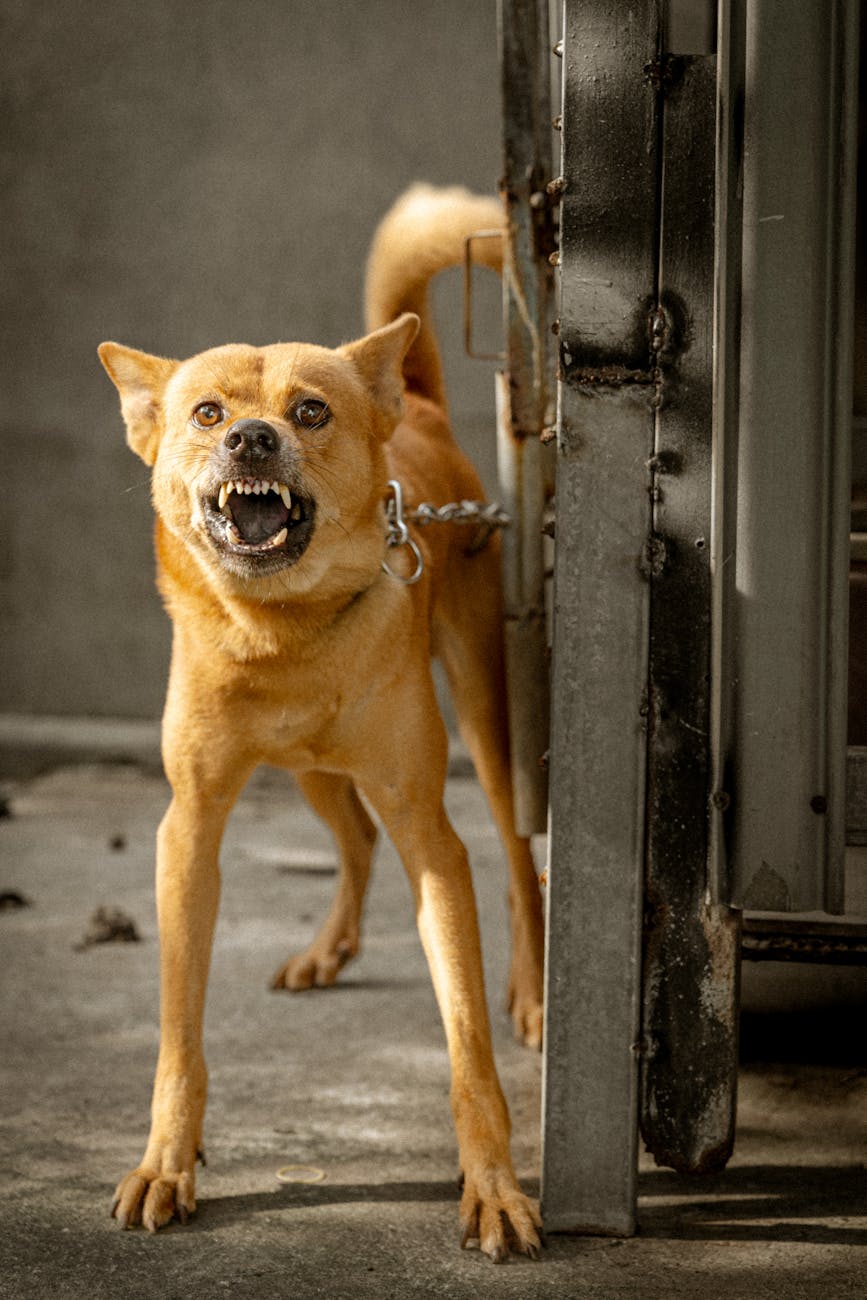
Resource guarding can be very obvious, like snarling and growling when you approach.
| In this photo, it’s pretty obvious that the dog wants us to go away from them. The flash from the camera is giving her spooky red eyes, but it makes it easy to see her pupils are pretty large. Given the context, this is a sign that she’s pretty scared. You can also see a smidge of white in the corner of her right eye, which means she’s not staring directly at the camera. She’s either warning a specific person or animal nearby or she’s not in the mood to fight. . Her ears are forward, body is stiff, and her mouth is far forward with the corners slightly behind her canines. Most of us know to stay away from this dog. This dog is close to biting, so it’s best to leave them alone. |  |
But it can be subtle
 | Here, this shiba is telling the shepherd to back off from the bone in front of them. Even though both dogs are fairly relaxed and lying down, the shiba is snarling a little, even though they’re not looking directly at the puppy. You can see lots of harsh shadows on the shiba’s face, showing off how tense they are. I often look for this to gauge their stress. This is a sign of discomfort. In this case, it’s probably because of the puppy. The shiba isn’t making direct eye contact, which means they’re not quite ready to escalate, but it’s not off the table yet. This behavior is a way to express what they’re feeling without having to get into a fight, even though they’re angry. The puppy has a closed mouth, pricked ears, and what appears to be a slight paw lift with their right front paw. The puppy is signaling that they don’t want any drama, and is trying to de-escalate the situation. |
 | If the object they want to keep is larger than them, dogs will also sit, stand, or lie down beside or in front of what they hold dear, known as body blocking. If your dog is guarding you, you may also feel them lean heavily on you, or place their butt on you, essentially putting their stank on you to mark you as theirs. This mixed breed dog has hard eyes, ears pointed forward, significant facial tension, and a slight paw lift with their right paw. If you look closely, you’ll see that the inner corner of their brows is higher than the outer corner, giving them a worried expression. The person may be holding this dog back from lunging, which only adds to their stress. |
What do I do if my dog is resource guarding?
First, stop doing whatever you’re doing.
Then, it’s time to make some decisions. Are they guarding something that’s rightfully theirs, like a meal, or is it something that can be potentially dangerous or valuable to you, like a shoe?
- If it’s supposed to be theirs, back off and let them be. Your dog will remember that you listen to a warning and will keep warning you and others in the household instead of escalating their behavior. Kyleth still tells me not to take her bowl if there’s food in it, and I listen.
- If it’s not supposed to be theirs, offer a trade.
But most importantly, do not punish them for guarding! It will only teach your dog that they were right to be anxious and their behavior will escalate. Dogs aren’t dumb, and they will remember that you plus the remote equals a bad time for them, and may feel the need to protect themselves.
Change the environment so it doesn’t happen
Next, look at the environment. What can you change in order to prevent guarding in the first place? Maybe the dogs need more space in between their bowls. Yes, it’s a pain to have to feed separately, but it’s cheaper than a vet bill! High value treats and toys should only be given when you can supervise. Prevent others from getting the high value item that belongs to your dog by giving them space to enjoy it without being harassed. For objects that they shouldn’t have, make sure that they are out of your dog’s reach. I know it’s easier said than done, especially if you aren’t the only member in your household and/or live in utter chaos, but the only way to prevent a puppy from chewing on shoes is to make sure they never have access to them in the first place.
Trade games are a safety must
Since guarding is a normal behavior, we want to teach our dogs to give up items willingly to us. Teaching your dog to trade one item for another helps them realize that you taking something away isn’t a big deal. There’s a secret to this, though: the item they get in exchange needs to be a good one. Izzy might be willing to trade a toy for some kibble, but if I try that with a bully stick, she has no problem telling me where I can shove that kibble. Up the awesomeness ante if they ignore your first offer.
Give them the new thing at their side so that they have to turn away from the object they’re guarding. For most dogs, you’ll have a second or two where you can move the thing they shouldn’t have away from them.
I’m not a big fan of taking a dog’s food bowl away if they guard it. I want my presence to be something they associate with good stuff, not anxiety. Instead of teaching them to tolerate me taking away their food bowl, I like to stop by with something extra tasty, like a piece of chicken or turkey, dropping it in or beside their bowl, and then walking away.
Training cues for guarding
There are two cues that I use when a dog is guarding: “Drop It” for objects in my dog’s mouth, and “Leave It” for everything else. Both are based on trade games because you will be offering them something nicer (to them) for the thing they already have.
Start training this with low-value items instead of high-value items, but if you have specific things you want them to leave alone, bring those into your training sessions once they’ve had a little practice. For purses, shoes, bags, and remotes, I like to reward anything they’re doing that’s not messing with the item so that they really understand it’s better (and more profitable!) to leave it alone.
“Leave It” is only half a sentence. What should they do after they’ve left the object alone? Most of the time, my answer is to move away from it, so I toss their reward away from them to give me time to pick up whatever Kyleth has managed to get her adorable little teeth on. It’s much easier to pick up whatever Kyleth is guarding when she’s several feet away.
As always, if you are not sure how to train a cue or you concerned about you or your household’s safety, seek help from a qualified, professional trainer.
Although guarding is a perfectly normal behavior in dogs, by learning the subtle ways your dog communicates with you, you can address the issue appropriately by giving them space and teaching them that both leaving things alone and giving things to you mean good things for them. This will keep everyone in your household safer, and your dog more confident that they will be heard and respected.

 Amy Writes Things